
Smart Mirrors: Why Seoul’s Beauty Fusion is 3 Years Ahead of the West
How South Korea’s Fusion of AI, AR, and Cultural Innovation Redefines Beauty Standards Globally
The Mirror That Knows You Better Than You Do
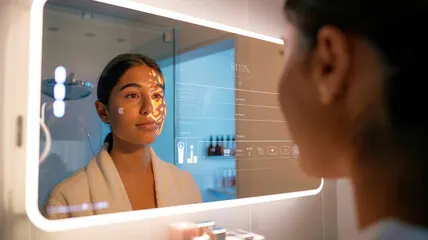
In a Seoul salon, a woman adjusts her bangs using a smart mirror that analyzes her face shape, suggests hairstyles trending in Paris, and predicts how her hair will look after a perm—all in real time. Meanwhile, Western beauty tech struggles to keep up with basic virtual try-ons.
This gap isn’t accidental. Seoul’s $15B beauty tech industry, fueled by AI, cultural obsession with innovation, and government backing, has leapfrogged the West by three years. Here’s why.
1. AI-Driven Personalization: Beyond Skin-Deep
Seoul’s Edge:
- Hyper-Personalized Diagnostics: Samsung’s MICRO LED Beauty Mirror scans skin for wrinkles, pigmentation, and erythema, then recommends products like innisfree Green Tea Seed Cream—paired with real-time moisture sensors for clinic-level accuracy .
- Cultural Customization: Startups like Mirrorroid collaborate with KAIST to develop AI that adapts hairstyles to diverse face shapes and textures, from Korean ulzzang trends to French bobs .
Western Lag: Most Western smart mirrors (e.g., Withings Omnia) focus on health metrics (weight, heart rate) but lack beauty-specific AI
2. AR/VR Integration: The Seoul Saloon Revolution
Seoul’s Edge:
- Virtual Try-Ons with Physics: AmorePacific’s Wanna Beauty AI uses generative AI and stable diffusion to simulate how makeup interacts with skin texture under different lighting—no more “cakey foundation” surprises .
- Hair Metaverse: At COSMOBEAUTY SEOUL 2025, salons demo AR mirrors that let users “test” holographic hair colors and cuts, reducing post-salon regret by 60% .
Western Lag: Western tools like Perfect Corp’s PerfectGPT offer basic virtual try-ons but lack real-time environmental adaptation (e.g., humidity’s impact on hairstyles)
3. Ecosystem Synergy: Tech Giants + Startups + Government
Seoul’s Edge:
- Corporate-Startup Collabs: LG Display partners with Mirrorroid for smart mirror hardware, while L’Oréal Korea co-develops Cell BioPrint with NanoEnTek for personalized anti-ageing solutions .
- Government Fuel: South Korea’s Ministry of SMEs funds beauty tech accelerators in Pangyo Techno Valley, offering R&D grants and global exhibition access (e.g., CES, InterCHARM) .
Western Lag: Silicon Valley’s beauty tech startups often lack equivalent institutional support, relying on VC whims .
4. Cultural Obsession: K-Beauty’s Data Goldmine
Seoul’s Edge:
- Consumer Data: Korean users willingly share selfies, skin logs, and hair histories via apps like Hush—training AI on 10M+ datasets for precision unmatched in the West .
- Trend Velocity: K-beauty’s 52-week product cycle (vs. the West’s 18-month R&D) forces rapid iteration. Samsung’s MICRO LED Mirror updates recommended skincare routines biweekly based on Seoul’s ever-shifting trends .
Western Lag: Western brands like Hilook focus on static diagnostics (e.g., acne tracking) without real-time trend integration.
5. Ethical Tech: Privacy vs. Progress
Seoul’s Tightrope:
- Data Dilemma: While Korean smart mirrors collect biometrics, laws like the Personal Information Protection Act mandate on-device processing. Mirrorroid’s hair simulations run locally, avoiding cloud leaks .
- Western Hesitation: GDPR and CCPA restrict data usage, stifling AI training. L’Oréal’s Mood Mirror (CES 2025) had to disable emotion tracking in Europe due to privacy lawsuits.
The Road Ahead: Can the West Catch Up?
Seoul’s 2025 Moves:
- Global Domination: Mirrorroid plans Canadian and U.S. subsidiaries, targeting Sephora and Ulta with AI stylists fluent in English, Spanish, and Mandarin .
- Wellness Expansion: Upcoming smart mirrors at HEALTH LIFESTYLE SEOUL 2025 will merge beauty diagnostics with mental health tracking (e.g., stress-induced acne alerts) .
Western Counterplay:
- Niche Innovation: Startups like MySize (Israel) develop smart mirrors for inclusive sizing but lack Seoul’s ecosystem depth .
- Regulatory Push: The EU’s AI Act may standardize beauty tech ethics, but at the cost of slowing innovation.
Read More
- 💄 AI-Powered Mental Health Apps: 2025’s Top Tools
Explore how Seoul’s tech ethos influences global mental wellness trends. - 🌐 Carbon-Negative Cities: Dubai & Singapore’s Blueprint
Compare Seoul’s tech leadership with sustainability pioneers.
Why Seoul Wins (For Now)
- Cultural Agility: K-beauty’s “test fast, fail faster” ethos outpaces Western caution.
- Tech-Art Fusion: Seoul treats beauty tech as art—see Smart Booth mirrors that blend AR hairstyles with K-pop selfie backdrops .
- Government Foresight: Subsidies for MicroLED R&D ensure Samsung stays 3 years ahead of competitors like Gentex .





Looking for a safe place to get KK33gamedownload. Don’t want no sketchy sites messing with my phone. kk33gamedownload
69vncom. That address has a ring to it. I’ll probably take some time today to give their betting services an actual solid assessment. Here’s the link: 69vncom
KkwinSlotAPK? Slot terus! Tapi lumayan buat iseng-iseng. Mudah-mudahan dapet scatter banyak! kkwinslotapk
I’ve spent a lot of time on s666xtinnude, and I can recommend it, is perfect! But take care with some links. Here is the URL s666xtinnude.
234betapp is pretty streamlined. Easy to use, even on my old phone. They got a good mix of slots and live games. Definitely worth downloading. Give 234betapp a whirl!
Yo, 69win10 isn’t half bad. It’s got that classic casino vibe going on. I won some decent cash there last week. Worth a look especially if you like these kind of sites. Go check 69win10 out.
79mbet? Yeah, I’ve played there a few times. The site’s alright, nothing too flashy, but the games are fun, and you can usually find a bonus code floating around. See for yourself at 79mbet.