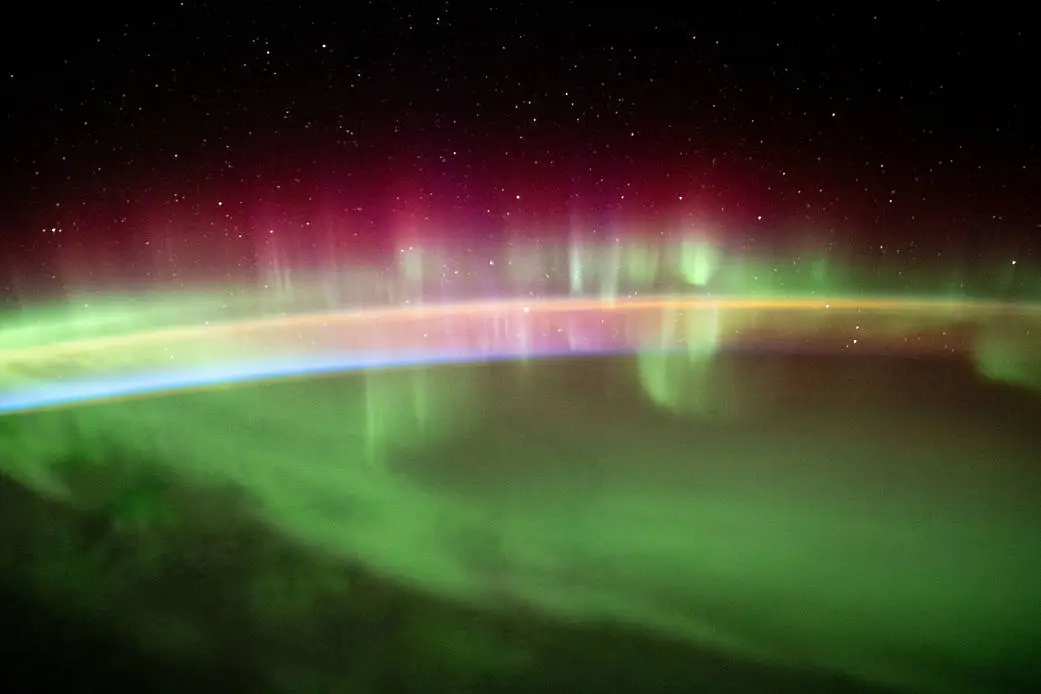

Earth vs. Mars : Why the Red Planet’s Auroras Is Unlike Anything on Earth
On March 18, 2024, NASA’s Perseverance rover made history by capturing the first-ever visible aurora on Mars—a faint green glow illuminating the planet’s night sky. This ground breaking discovery, published in Science Advances , challenges our understanding of planetary auroras and offers a tantalizing glimpse of what future astronauts might witness.
Unlike Earth’s iconic northern lights, Mars’ auroras are ghostly, uniform, and born from a chaotic interplay of solar storms and a fractured magnetic field. Let’s explore how these alien light shows differ from Earth’s—and why they matter for space exploration.
What Are Auroras?
Auroras are one of the most enchanting phenomena in planetary science—but they’re also grounded in harsh space physics.
When charged particles from the Sun (solar wind) collide with a planet’s magnetic field and upper atmosphere, they generate light displays. These interactions excite atmospheric atoms, causing them to glow in different wavelengths.
Earth’s Light Show
On Earth, we see auroras near the magnetic poles—the iconic Northern Lights (Aurora Borealis) and Southern Lights (Aurora Australis). They typically glow green (from oxygen), with occasional red and purple hues depending on altitude and gas composition. Earth’s strong global magnetic field funnels solar particles toward the poles, creating predictable auroral ovals.
Mars’ Light Show
Mars, however, plays by very different rules. It lost its global magnetic field billions of years ago (NASA.gov). What remains are patchy, crustal magnetic fields, mostly in the southern hemisphere. Yet somehow, auroras still occur. These are primarily:
Proton auroras – formed when solar hydrogen particles steal electrons from Mars’ atmospheric hydrogen, emitting ultraviolet light.
Diffuse auroras – caused by high-energy solar particles interacting directly with Mars’ upper atmosphere during solar storms.
Earth vs. Mars Auroras: Key Differences
1. Magnetic Fields Matter
Earth’s strong magnetic shield channels solar particles to the poles, creating concentrated auroral ovals. Mars, with only patchy magnetic remnants, has no such defense. Solar storms slam into its thin atmosphere globally, sparking auroras that engulf the entire planet.
2. Colors of the Sky
Both planets share green auroras caused by oxygen atoms emitting light at 557.7 nm. However, Mars’ atmosphere—95% CO₂ and 0.13% oxygen—produces a fainter, dust-obscured glow. Perseverance’s cameras barely captured it, requiring editing to remove glare from Mars’ moon Phobos.
3. Location & Visibility
Earth’s auroras dazzle near the poles, while Mars’ auroras blanket the entire night sky during solar storms. The March 2024 event revealed a uniform green haze in Jezero Crater, visible only with rover instruments due to its faintness . Future astronauts might witness brighter displays during intense solar activity.
4. Solar Storm Impact
Mars’ thin atmosphere offers little protection from solar energetic particles (SEPs). Recent solar maximum activity—peaking earlier than predicted—has triggered record-breaking auroras, including a rare “aurora hat trick” in February 2024. These storms also pose radiation risks for human missions.
You May Like:
The Science Behind Perseverance’s Discovery
Capturing Mars’ aurora required unprecedented coordination:
- Predictive Modeling: Researchers calculated optimal angles for Perseverance’s Mastcam-Z and SuperCam to target the 557.7 nm wavelength.
- Solar Storm Alerts: NASA’s Moon-to-Mars Space Weather Office flagged a March 15 CME, enabling rover teams to prepare.
- Cross-Mission Collaboration: MAVEN and ESA’s Mars Express confirmed SEP influxes during the event, validating the discovery.
Implications for Human Exploration
The discovery isn’t just poetic—it’s practical:
- Radiation Risks: Auroras signal intense solar storms, critical for shielding astronauts.
- Atmospheric Clues: Auroras reveal how Mars lost its water, aiding climate studies.
- Astronaut Morale: Future crews could witness green skies, a surreal reminder of Earth’s beauty.
Could Future Astronauts See Martian Auroras?
In theory? Yes. In practice? It’s complicated.
Future Mars settlers equipped with UV-sensitive goggles or imaging tech could witness auroras—especially during strong solar activity. But exposure to solar storms is dangerous. Without a global magnetosphere, Mars offers little radiation protection. NASA’s research suggests that underground shelters or magnetic shielding will be vital for long-term survival (NASA HLS Science Definition Report).
Still, the psychological effect of seeing an aurora on another planet—even a faint one—could become a symbolic milestone for human colonization. As Dr. Shannon Curry, principal investigator for MAVEN, noted:
“Auroras are not just beautiful. They’re a mirror reflecting the planet’s magnetic and atmospheric past.”
FAQs
Q: Why are Mars’ auroras green?
A: Oxygen atoms emit green light at 557.7 nm, just like on Earth—but Mars’ thin atmosphere makes them fainter.
Q: Could astronauts see Martian auroras?
A: Yes! During strong solar storms, a green glow may be visible, though dust might obscure the view.
Q: How do Martian auroras form without a magnetic field?
A: Solar particles directly bombard the atmosphere, exciting gases globally.
Q: Why are Mars auroras different from Earth’s?
A: Mars lacks a global magnetic field, so solar particles interact directly with its thin atmosphere, creating faint, planet-wide auroras.
Q: Do Mars auroras pose risks to astronauts?
A: Yes—auroras signal intense solar radiation, which future explorers would need to shield against.
Conclusion
Mars’ auroras are more than a cosmic curiosity—they’re a window into the planet’s atmospheric past and a beacon for future explorers. As solar maximum continues, expect more revelations from Perseverance and MAVEN.
For now, this green glow reminds us that even a barren world can harbor unexpected beauty.
Explore Further:



Logged into jili666login, and the site’s running smoothly. Found a few games I like already, so I’m set for the night. Log in and play: jili666login
Just signed up to 67bet32. Seems legit! Hoping for some good wins! Will report back with my findings. If you wanna give it a spin yourself: 67bet32
Yo, Goldsbetgame caught my eye. I went through it and noticed some games I think are fire, I’m gonna see if it’s worth more time. goldsbetgame
If you are looking for some fun, try out merryph12! They have a great selection of games and the site is always running smoothly. Definitely worth a look! merryph12