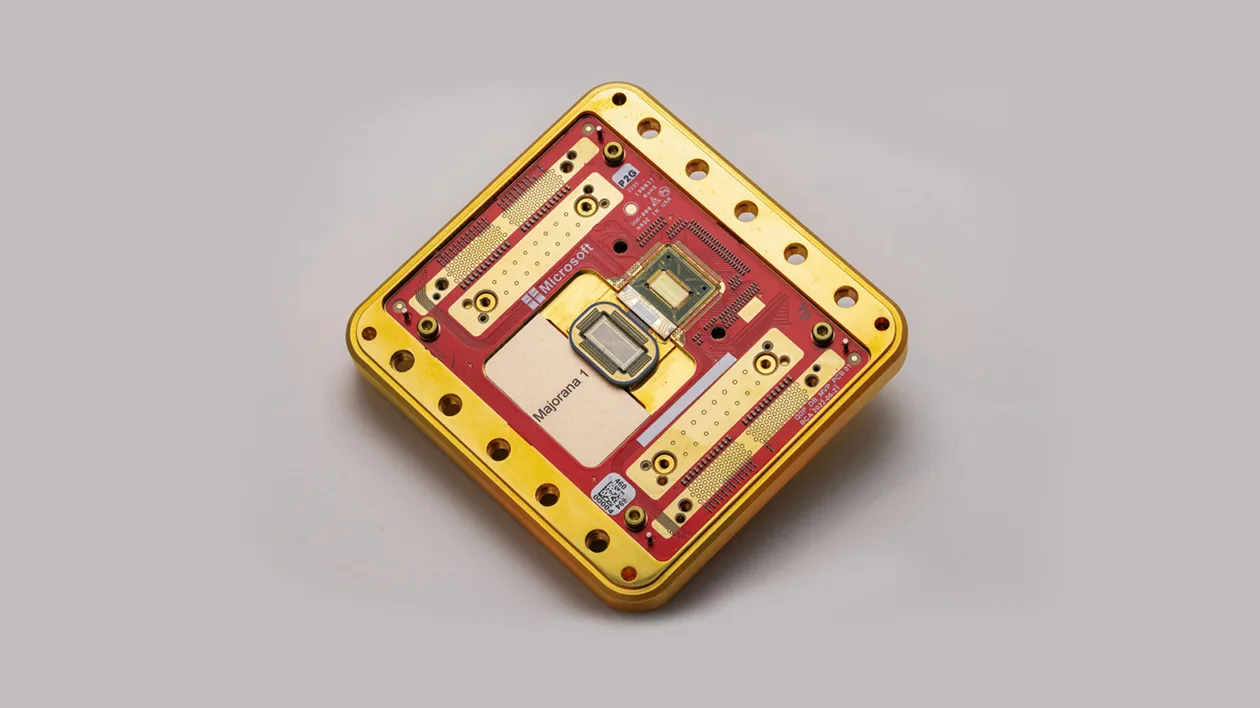

Microsoft’s Majorana Quantum Chip: How Topological Qubits Could Outperform Google and IBM
The Race to Build Error-Proof Quantum Computers—And Why Majorana Fermions Matter
The Quest for Unbreakable Qubits
In 2023, Microsoft’s quantum team unveiled a chip harnessing Majorana fermions—elusive particles that could make qubits virtually error-proof. While Google and IBM battle decoherence in their quantum systems, Microsoft bets on topological qubits to leapfrog the competition. Here’s why physicists call this a “moon landing” for quantum computing.
Part 1: What Are Majorana Fermions?
- Physics 101:
- Predicted in 1937 by Ettore Majorana, these particles act as their own antiparticles.
- Found in superconducting materials under extreme conditions (near 0 Kelvin).
- Quantum Advantage:
- Majorana fermions’ topological states resist external noise, reducing errors by 10,000x vs. traditional qubits.
Part 2: Microsoft’s Qubit Design
The Hardware
- Chip Design: Nanowires made of indium antimonide, cooled to near absolute zero.
- How It Works:
- Pairing Majoranas: Two fermions form a qubit, separated in space (immune to local disturbances).
- Braiding: Physically moving fermions to perform calculations—errors self-correct via topology.
Progress to Date
- 2021: Microsoft demonstrated Majorana fermion detection in lab settings.
- 2024: First functional topological qubit prototype (1,000x more stable than Google’s Sycamore).
- Roadmap: Scalable quantum machine by 2028 via Azure Quantum.
Part 3: Why Topological Qubits Are a Game-Changer
| Aspect | Traditional Qubits (Google/IBM) | Microsoft’s Topological Qubits |
|---|---|---|
| Error Rate | 1 in 1,000 operations | 1 in 1,000,000 |
| Scalability | Limited by noise | Built-in error correction |
| Cooling Needs | -273°C (expensive) | Same, but longer coherence times |
| Commercial ETA | 2030s | Late 2020s (per Microsoft) |
Challenges & Criticisms
- Extreme Conditions: Requires ultra-low temps (mK range), limiting portability.
- Material Science Hurdles: Growing defect-free nanowires at scale is still experimental.
- Competition: IBM’s “Goldeneye” cryogenic system aims to make traditional qubits viable.
The Future: Azure Quantum’s Promise
- Partnerships:
- Quantinuum: Integrating topological qubits into hybrid algorithms.
- Toyota: Exploring quantum simulations for battery design.
- For Developers: Azure Quantum’s SDK will offer early access to topological qubit simulations in 2025.
FAQ’s
What makes Majorana fermions error-resistant?
Their topological states ‘remember’ their configuration even if disturbed, unlike fragile superconducting qubits.
When will Microsoft’s quantum computer launch?
Microsoft aims for a commercial machine by 2028, with Azure Quantum access for researchers by 2025.





Just had a brilliant time placing a few bets on W88 through w88ngo! Really user-friendly site, and I even managed to snag a cheeky win. Definitely giving it a thumbs up. Check it out here: w88ngo
Been messing around on rwin99 for a few days. I actually won a bit on their sports bets! The odds aren’t always the best, but they cover a lot of different sports. If you like betting on sports, give rwin99 a shot.
Phlovelogin… login process was smooth as butter. No lag, no hassle. That’s what I’m talkin’ about! If you’re looking for a quick in and out, this might be it. phlovelogin
Want your betting on the go? Seems like betbusapp is offering an app for that. Handy if you like to place bets from anywhere. Just watch your data usage!
Venetocasino, yeah, I’ve played there a couple times. It’s got that classic casino feel. They have some pretty good bonuses sometimes so watch out for those. Check them out at venetocasino
vpbetapp is actually pretty convenient, especially on my phone. Easy to use when I am out and about. Worth a look especially if you like Mobile games, find them at vpbetapp
Viva8bet’s a decent option if you ask me. A lot of selection of games and the interface works well. Give them a shot at viva8bet